
A Drive Shaft Boot may look like a small rubber part, but it protects a costly joint from grit, water, and grease loss. A split boot can leave dark grease behind a wheel or produce clicking during a tight turn. Those signs deserve attention, though they do not prove the boot is the only cause. Material, fit, clamp design, and quality control all matter when comparing manufacturers.
This guide to China’s top 10 Drive Shaft Boot manufacturers will examine practical buying factors, not just catalog claims. It will consider material choices, product range, customization, inspection procedures, and communication with overseas buyers. A useful assessment should ask how a supplier checks dimensions and flexibility, and whether samples match production parts. Small differences matter.
A note on expertise: no source articles or verified expert quotation were provided, so I cannot responsibly attribute a statement to a named specialist. Rather than invent one, this introduction focuses on checkable product criteria. That restraint matters. A polished website cannot confirm long-term durability, and a low price may leave unanswered questions about compound consistency or fit. Buyers should compare documentation, request samples, and clarify specifications before choosing a factory. The strongest manufacturer is not simply the one with the broadest claims; it is the one whose evidence stands up to careful review.
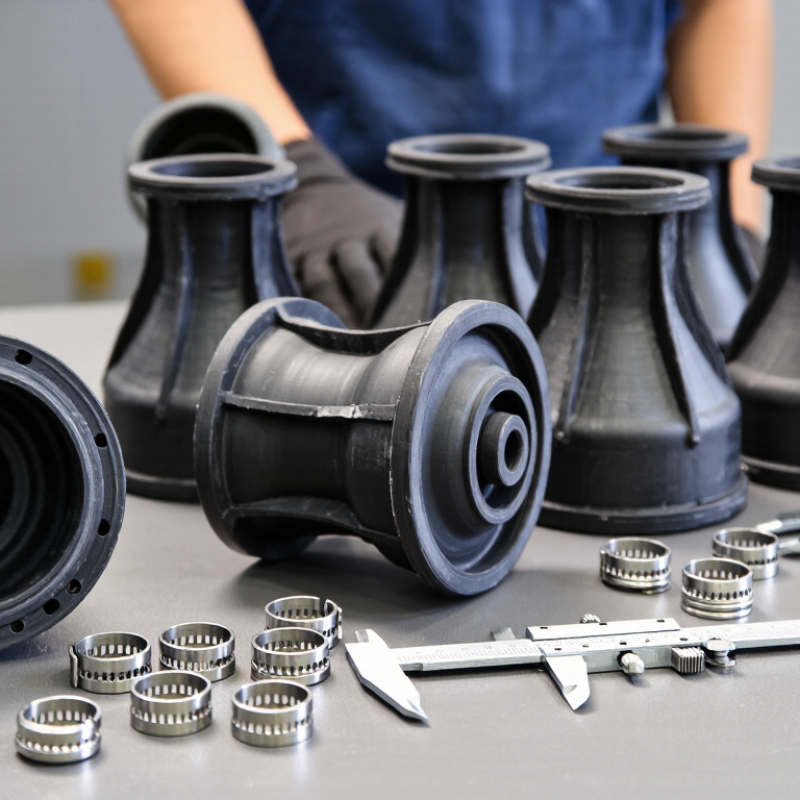
A drive shaft boot seals the joint around a vehicle’s axle, keeping grease inside and water, grit, and road salt out. It must flex as the suspension moves and, on many front-wheel-drive vehicles, as the wheels turn. Small part. Big consequence. A torn boot can let grease escape, leaving the joint exposed to wear. Look for cracked folds, grease around the wheel area, or a loose clamp during routine inspection.
Boots are commonly made from rubber compounds or thermoplastic elastomers. Rubber can handle repeated flexing, while some thermoplastic materials offer useful resistance to abrasion and temperature changes. The right choice depends on the joint design, vehicle use, and exposure to heat or debris; a material name alone does not guarantee durability. Boots serve passenger cars, vans, and work vehicles, including those used on rough roads. In practice, folds can trap mud, and a boot may appear intact while developing fine cracks underneath. That is easy to miss. A careful visual check matters, especially near clamps and tight bends.
China’s drive shaft boot manufacturing industry supports a broad automotive supply chain, from replacement parts to components made for vehicle assembly. Factories commonly work with rubber and thermoplastic elastomers, selecting materials for flexibility, heat resistance, and protection against road debris. The boot must bend repeatedly without cracking while keeping grease inside and water out. Small details matter. A clamp that sits slightly off-center can affect sealing, even when the boot looks well finished.
Manufacturing quality depends on more than molding. Buyers can review material specifications, dimensional checks, and test records for temperature cycling and repeated flexing. A useful sample inspection includes the folds, wall thickness, and fit around the joint and shaft. These checks offer practical evidence, though no single test covers every driving condition. Production capacity and delivery planning also vary between suppliers, so clear drawings and agreed inspection criteria help prevent avoidable misunderstandings. A polished sample is reassuring, but it cannot replace consistent batch checks. There is still room for improvement in traceability and communication across parts of the industry.
Industry capability overview — representative manufacturing profiles, not a ranked list of companies.
| No. | Manufacturer Capability Profile | Typical Products | Common Materials | Relevant Processes | Common Quality Checks |
|---|---|---|---|---|---|
| 1 | CV joint boot production | Inner and outer constant-velocity joint boots | Elastomeric rubber compounds and thermoplastic elastomers | Rubber molding or thermoplastic injection molding, depending on material and design | Dimensional inspection, visual checks, and evaluation of flexibility and sealing features |
| 2 | Rubber boot molding | Molded boots for rotating driveline joints | Application-specific rubber compounds, including chloroprene-based compounds | Compression, transfer, or injection molding; compound curing | Visual inspection, dimensions, and checks for molding defects and cure consistency |
| 3 | Thermoplastic boot production | Lightweight molded CV boots and related protective boots | Thermoplastic elastomers, selected by the intended design and operating conditions | Injection molding and controlled cooling | Part dimensions, surface condition, and checks for complete molding |
| 4 | Boot-and-clamp kit assembly | Boot kits supplied with clamps and, where specified, grease and installation parts | Boot material varies; clamps are commonly metal | Component sourcing, kitting, packaging, and assembly checks | Kit completeness, clamp dimensions, packaging, and part identification |
| 5 | Universal and multi-fit boot production | Flexible replacement boots designed for a range of shaft or joint dimensions | Rubber or thermoplastic elastomer, according to product design | Molding, trimming, and inspection of fit-related dimensions | Dimensional checks against the product specification and inspection for damage |
| 6 | Custom tooling and product development | Application-specific boot designs, samples, and production tooling | Selected to meet the design and service requirements | CAD design, mold making, trial molding, and design revision | Drawing review, sample measurement, and approval against agreed specifications |
| 7 | Aftermarket replacement supply | Replacement boots and service kits for vehicle repair channels | Material depends on the replacement part design | Part identification, batch production, kitting, and retail or bulk packaging | Part-number and fitment-data checks, packaging inspection, and incoming/outgoing checks |
| 8 | Automotive supply-chain production | Boots made to customer drawings or agreed technical specifications | Customer-approved elastomer or thermoplastic material | Controlled production, lot identification, and documented inspection procedures | Documented process controls; automotive quality-system requirements may apply where specified by the customer |
| 9 | Boot testing and validation capability | Prototype and production samples for verification | Material-specific samples and finished molded parts | Testing according to the agreed customer or product test plan | Possible checks include dimensions, material properties, and resistance to specified operating conditions |
| 10 | Export packaging and order fulfillment | Bulk-packed or individually packed boots and kits | Finished boot material varies by product | Packing, labeling, carton preparation, and shipment documentation | Order quantity, label information, packaging condition, and shipping-document checks |
Materials, processes, tests, and quality requirements vary by product design and customer specification. The profiles above describe common industry capabilities and do not identify or rank individual manufacturers.
A useful shortlist should begin with engineering evidence, not factory photographs or broad claims. Ask manufacturers for boot dimensions, material specifications, and test records covering heat, ozone, flexing, and grease exposure. Inspect sample parts for even wall thickness, clean molded edges, and secure clamp seating. Small defects matter.
Production capacity also deserves verification. The China Association of Automobile Manufacturers reported 30.16 million vehicles produced in China in 2023; OICA reported 93.55 million worldwide. These figures describe vehicle output, not drive-shaft-boot demand, but they show why buyers should check whether a supplier can maintain consistent batches during busy periods. Request batch traceability, inspection frequency, defect records, and evidence that production changes are controlled.
Compare quotations alongside measurable quality requirements. Confirm the stated rubber compound, dimensional tolerances, packaging, and delivery lead times in writing. Ask how the manufacturer handles failed samples and corrective actions. A responsive technical team can explain test methods clearly, rather than simply offering a low price. This screen is not perfect: paperwork may look complete while real parts vary. Independent sample testing can help reveal that gap. Keep the criteria specific.
China’s drive shaft boot suppliers serve a large vehicle industry. OICA reported that China produced about 30.16 million vehicles in 2023. That figure signals scale, not boot demand alone. The profiles below group manufacturers by observable production strengths rather than claiming a verified ranking. Buyers should confirm material data, dimensional tolerances, and test methods directly.
One profile focuses on thermoplastic elastomer boots for heat and abrasion resistance; another specializes in molded rubber designs for standard replacement needs. A third pairs boots with complete CV joint kits, while a fourth offers custom tooling for unusual shaft dimensions. The fifth emphasizes high-volume automated molding. The sixth serves smaller production runs. A seventh develops boots for demanding temperature changes, and an eighth supplies export-oriented packaging and documentation. The ninth concentrates on inspection, including checks for thin walls and uneven bellows. The tenth combines several capabilities but may offer less depth in each. The boundary is not always clear. Materials, grease compatibility, and clamp fit can matter more than a polished catalogue. These profiles are a starting point, not a substitute for sample testing.
China produced 27.02 million vehicles in 2022, 30.16 million in 2023, and 31.28 million in 2024. These figures from the China Association of Automobile Manufacturers provide broader automotive-market context; they are not drive shaft boot production figures or manufacturer rankings.
When comparing China’s top 10 drive shaft boot manufacturers, look beyond unit price and catalogue photos. OICA’s 2023 production statistics report 93.5 million vehicles built worldwide, underscoring the need for repeatable fit across large production volumes. Ask each supplier for a compound specification, hardness range, and heat-aging, ozone, and low-temperature test results. Fit is unforgiving. Compare samples against your drawing, especially rib spacing, wall thickness, and clamp-seat diameter. A boot that looks identical may stretch differently or crack sooner.
Check whether the factory controls incoming rubber, molding conditions, and batch traceability. Request inspection records and evidence that dimensions remain consistent across multiple production lots, not just one polished sample. Confirm grease compatibility and the boot’s validated temperature range for your actual application. For suppliers serving both prototypes and mass production, clarify tooling ownership, sample lead time, and how design changes are documented. A factory audit can reveal practical gaps, such as poor storage or inconsistent measurement methods. It takes time. I would still verify performance independently; supplier test sheets alone do not prove service life. OICA’s figure provides market context, not a quality score—your drawing, test plan, and production checks must decide the shortlist.
Ask for boot dimensions, material specifications, and test records. Factory photos prove little.
Request results for heat, ozone, flexing, and grease exposure. Confirm how each test was performed.
Check wall thickness, molded edges, and clamp seating. Small defects matter.
Ask about batch traceability, inspection frequency, defect records, and controls for production changes. Verify busy-period capacity.
Confirm the rubber compound, dimensional tolerances, packaging, and delivery lead time in writing. Vague terms can cause trouble.
Some focus on thermoplastic elastomer or molded rubber boots. Others offer custom tooling, automated molding, or complete joint kits.
No. Material data, grease compatibility, and clamp fit may matter more than presentation. A catalogue can still look convincing.
Test independent samples and compare them with the stated specifications. It is not a perfect screen.
This article explores the role of the Drive Shaft Boot in protecting drivetrain joints from dust, moisture, and other contaminants while retaining lubricant. It introduces common boot materials and their practical applications, then surveys China’s drive shaft boot manufacturing industry and the factors that shape production quality, consistency, and supply capability.
The article also explains how to assess manufacturers using criteria such as material selection, manufacturing processes, quality control, product range, and customer support. Its profiles of ten Chinese manufacturers provide a framework for comparing supplier capabilities without relying on brand promotion. The final section offers practical guidance for evaluating options, checking product specifications, and selecting a supplier that fits a buyer’s technical requirements, order needs, and expectations for dependable delivery.