
0%

Control Arm Bushing selection has become a serious sourcing decision for global automotive buyers. These components manage vibration, alignment movement, and steering response between the control arm and chassis. A small rubber tear can create clunks, uneven tire wear, or unstable braking. That detail matters in daily operation.

Grand View Research reports continued growth in the global automotive suspension systems market, driven by vehicle production, electrification, and replacement demand. Fortune Business Insights also identifies rising maintenance requirements as a major aftermarket factor. However, both reports usually group bushings within wider suspension categories. Their data is useful, but not perfectly specific. Buyers should remain cautious.

This guide examines ten Control Arm Bushing types, including rubber, polyurethane, hydraulic, spherical, and bonded designs. It compares material behavior, load capacity, ride comfort, installation complexity, and regional supply considerations. SAE technical publications and manufacturer test data provide supporting reference points. Independent validation remains essential.

Suspension engineer John C. Dixon, author of Suspension Analysis and Computational Geometry, offers a practical reminder: “Suspension design is always a compromise between competing requirements.” That principle applies directly here. A polyurethane bushing may sharpen steering feel, yet transmit more road noise. A hydraulic design may improve comfort, but require tighter quality control. Nothing is universal.

Buyers should inspect hardness ratings, temperature resistance, dynamic stiffness, salt-spray performance, and dimensional tolerances. They should also request batch traceability and real-vehicle testing. Laboratory results can look excellent. Real roads can disagree. This article provides a structured starting point, not a substitute for engineering validation across climate, vehicle platform, and driving conditions.
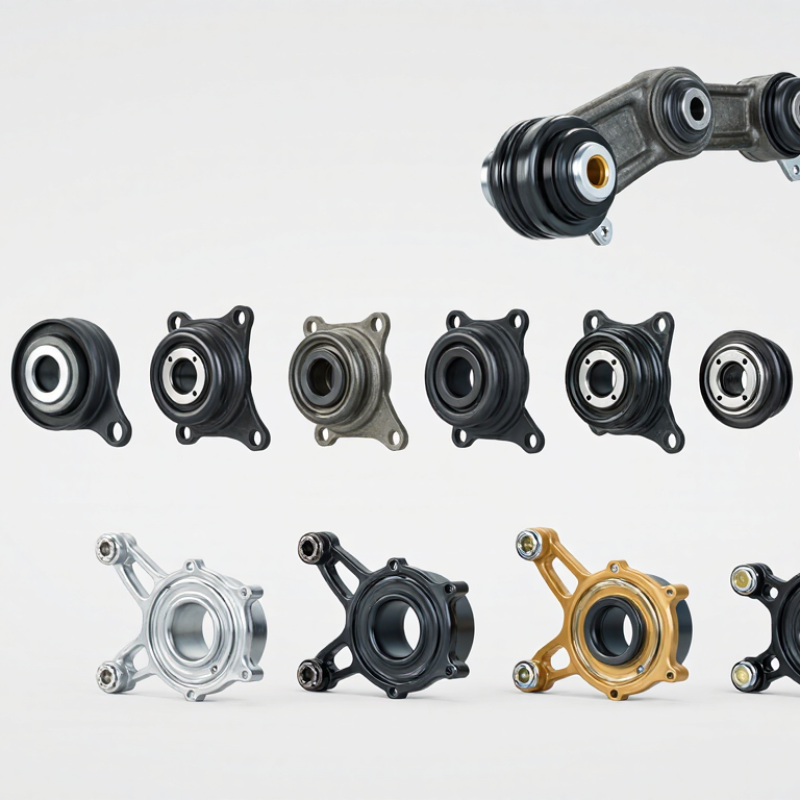
Top 10 Control Arm Bushing Types for Global Buyers

Control Arm Bushings: Purpose, Design, and Key Performance Factors

Control arm bushings connect the suspension arm to the vehicle frame. They absorb road shock while allowing controlled movement. This small component influences steering accuracy, tire contact, ride comfort, and cabin noise. During inspection, cracked rubber, fluid leakage, or uneven wear can signal declining performance.

Design varies by application. Bonded rubber bushings suit many passenger vehicles because they balance flexibility and durability. Hydraulic bushings add fluid chambers for improved vibration control. Polyurethane versions often provide firmer response, but may transmit more road noise. Spherical designs allow precise movement in demanding suspension systems.

Buyers should match each type with load direction, mounting space, temperature range, and expected road conditions. Material hardness alone cannot predict service life. Engineers should review radial stiffness, torsional compliance, fatigue cycles, corrosion resistance, and dimensional tolerances.

Testing should include cold starts, high-temperature operation, water exposure, and repeated articulation. A bushing that performs well in a laboratory may behave differently on rough roads or overloaded vehicles.

That deserves honest review.

Manufacturing consistency matters too; small voids, poor bonding, or incorrect press-fit dimensions can cause early failure. Ask suppliers for inspection records, test methods, batch traceability, and clear technical drawings before approving global shipments. No design is perfect. The practical choice balances comfort, handling, durability, and total operating cost.

Top 10 Control Arm Bushing Types Used in Global Vehicle Markets

Control arm bushings vary widely across global vehicle markets because suspension layouts, road surfaces, and service habits differ. The ten common types include bonded rubber, hydraulic, polyurethane, spherical, voided, split, two-piece, press-in, bolt-on, and eccentric adjustable bushings. Each design changes ride comfort, steering response, or alignment control.

Bonded rubber bushings remain common in passenger vehicles. They reduce vibration through a flexible rubber sleeve. Hydraulic versions add fluid chambers for improved damping on uneven roads. Polyurethane offers sharper response, but it may transmit more road noise. Spherical bushings support precise movement in performance-oriented applications. They need careful sealing against dust and water.

Voided bushings use shaped gaps to control movement in specific directions. Split and two-piece designs simplify replacement during field repairs. Press-in types require accurate housing dimensions and suitable installation tools. Bolt-on bushings can reduce labor time when the mounting structure allows access. Eccentric adjustable bushings help correct alignment after suspension modifications or uneven wear.

In practical inspections, cracks, fluid leakage, crushed rubber, and shifted sleeves are useful warning signs. Fit matters. A harder bushing is not automatically better. Global buyers should compare load rating, temperature range, rubber hardness, corrosion protection, and dimensional tolerance. Packaging also deserves attention, especially in humid shipping routes. Some catalog descriptions remain vague, and that creates avoidable mistakes. Verification against the vehicle’s axle design and service environment is still essential.

How Each Bushing Type Fits Different Suspension Applications

Top 10 Control Arm Bushing Types for Global Buyers

How Each Bushing Type Fits Different Suspension Applications

Control arm bushings are not interchangeable comfort parts. Their design changes steering feel, noise, durability, and alignment control. Solid rubber bushings suit passenger cars needing quiet, compliant movement. Hydraulic bushings help luxury vehicles absorb small road impacts. Polyurethane bushings fit performance and heavy-duty applications, but may transmit more vibration. Voided rubber bushings allow controlled flexibility for front suspensions. Bonded bushings work well where axial movement must remain limited. Press-fit bushings support economical replacement programs. Sleeve bushings suit simple pivot points and moderate loads. Eccentric bushings help correct alignment during repair. Split bushings are practical for restricted service access. Spherical bushings fit motorsport or precise steering systems, although they reduce isolation.

Application conditions matter more than catalog descriptions. Light commercial vehicles often need reinforced rubber or hydraulic designs around high payload cycles. Off-road platforms may require polyurethane or spherical constructions, but dirt, water, and corrosion can shorten service life. For electric vehicles, added battery mass increases suspension loading. The IEA’s Global EV Outlook 2024 reported nearly 14 million electric car sales in 2023, representing about 18% of global new-car sales. That shift makes load validation increasingly important.

Material selection should follow temperature, road salt, deflection, and expected mileage. ASTM D2000 helps classify elastomer performance, yet it does not replace vehicle-level testing. A softer bushing can improve ride quality, but excessive compliance may disturb wheel alignment under braking. I would not choose polyurethane everywhere. That shortcut often creates harshness, and sometimes premature noise. Finite-element analysis, compression testing, and fleet trials provide better evidence than appearance alone.

Top 10 Control Arm Bushing Types for Global Buyers

How each bushing type fits different suspension applications

The comparative index reflects the typical engineering characteristics of each bushing design: ride isolation, handling precision, and load durability. Higher values indicate stronger suitability for that application priority; actual performance depends on vehicle geometry, material formulation, temperature, and operating load.

Material, Compatibility, and Quality Criteria for International Buyers

Global buyers face ten common control arm bushing types: rubber, polyurethane, hydraulic, bonded, voided, split, spherical, flanged, eccentric, and adjustable designs. Each serves a different suspension requirement. Natural or synthetic rubber usually delivers quieter operation and better vibration isolation. Polyurethane offers stronger steering response, but it can transmit more road noise. Hydraulic bushings improve ride comfort through fluid damping. Spherical and adjustable designs suit motorsport or specialized geometry, not every road vehicle.

Compatibility starts with more than outer diameter. Buyers should verify control-arm material, bore size, sleeve width, bolt diameter, suspension position, and permitted deflection. A front lower bushing may look similar to a rear unit, yet its load path can differ sharply. Check left-hand and right-hand drive applications. Confirm vehicle generation, engine weight, and regional suspension specifications. Small errors create uneven tire wear.

Quality testing needs measurable evidence. ISO 9001 certification supports process control, but it does not prove product durability. Ask for rubber hardness data, tensile strength, ozone resistance, salt-spray results, and fatigue-cycle reports. A 2024 S&P Global Mobility analysis placed the average U.S. vehicle age at about 12.6 years, increasing replacement demand. ACEA reported an average European passenger-car age of 12.5 years in 2022. Older vehicles need resilient materials, not merely cheaper parts. ASTM and SAE test references help, although test conditions may not match local roads. That gap deserves review. Suppliers should provide batch traceability, dimensional inspection records, and clear warranty terms before shipment.

How to Select and Source the Right Control Arm Bushings Globally

Selecting control arm bushings globally requires more than matching outer diameter and bolt size. Buyers should compare rubber-bonded, hydraulic, polyurethane, spherical, voided, slotted, eccentric, split, press-in, and bolt-on designs. Each type affects ride comfort, steering response, service life, and installation time. Start with vehicle platform, suspension geometry, load rating, temperature range, and road conditions. City fleets may need quiet hydraulic bushings. Heavy-duty routes often demand reinforced rubber or polyurethane. Spherical designs can improve movement, but they may transmit more vibration. That trade-off is easy to underestimate.

For sourcing, send suppliers complete drawings, vehicle references, hardness requirements, and acceptable dimensional tolerances. Request material declarations, test reports, production samples, and batch traceability. Verify rubber hardness, metal sleeve alignment, bonding quality, and corrosion protection. Use a third-party laboratory when supplier documents lack detail. Samples should survive compression, torsion, heat aging, salt exposure, and repeated cycling. Test results must match the intended market’s technical requirements. A sample that performs well on a smooth road may fail on rough roads.

Compare landed cost, not only unit price. Include tooling, packaging, freight, duties, inspection, and replacement risk. Confirm carton labeling and moisture protection before shipment. Ask for a realistic production lead time, not an optimistic promise. A lower quotation can hide thinner sleeves or inconsistent rubber compounds. Even experienced buyers may overlook installation orientation. Marking the correct direction on drawings helps prevent costly returns. Specifications are sometimes incomplete at the beginning, so record every assumption and review it before approval.

Top 10 Control Arm Bushing Types for Global Buyers - How to Select and Source the Right Control Arm Bushings Globally

No. Control Arm Bushing Type Construction and Material Typical Dimensional Range Typical Vehicle Application Main Advantages Common Limitations Key Sourcing and Inspection Points
1 Bonded Rubber Bushing Natural or synthetic rubber chemically bonded to an inner sleeve and an outer metal shell. Inner bore: 10–22 mm
Outer diameter: 30–65 mm
Length: 30–70 mm
Passenger cars and light commercial vehicles requiring balanced ride comfort and handling. Low noise and vibration; good sealing; predictable compliance; widely available in original-equipment-style designs. Rubber fatigue can occur under excessive heat, oil exposure, or continuous high articulation. Confirm rubber compound, hardness, bonding strength, sleeve concentricity, press-fit dimensions, and orientation marks.
2 Voided Rubber Bushing Rubber body with engineered voids or cavities that control radial and axial stiffness. Inner bore: 12–22 mm
Outer diameter: 35–70 mm
Length: 35–75 mm
Front control arms where ride comfort, steering refinement, and controlled compliance are important. Provides directional stiffness; absorbs road shock effectively; reduces transmitted vibration. Void geometry is application-specific; incorrect orientation can significantly change handling behavior. Request void shape drawings, installation orientation, stiffness data by direction, and durability test results.
3 Hydraulic or Fluid-Filled Bushing Elastomeric body containing a sealed fluid chamber and flexible internal passages or membranes. Inner bore: 12–24 mm
Outer diameter: 40–75 mm
Length: 40–80 mm
Vehicles designed for enhanced isolation from low-frequency road inputs and engine or suspension vibration. Excellent damping performance; improves comfort; can reduce harshness over uneven roads. More complex and costly; fluid leakage or membrane damage can cause rapid performance loss. Check leakage resistance, fluid compatibility, chamber integrity, temperature range, and dynamic stiffness performance.
4 Polyurethane Bushing Cast or molded polyurethane, usually installed with metal sleeves or washers. Inner bore: 10–25 mm
Outer diameter: 25–60 mm
Length: 25–70 mm
Performance-oriented passenger vehicles, off-road vehicles, and applications requiring higher resistance to deformation. High resistance to abrasion and oil; maintains geometry under load; available in multiple hardness levels. May transmit more noise and vibration; can squeak if lubrication and surface finish are unsuitable. Specify polyurethane hardness, compression set, tear strength, operating temperature, sleeve fit, and approved lubricant type.
5 Spherical or Uniball Bushing Precision spherical bearing or spherical joint housed in a metal cup or reinforced insert. Ball bore: 12–25 mm
Housing diameter: 30–60 mm
Width: 20–45 mm
Motorsport, heavy-duty suspension, and applications requiring high articulation with minimal compliance. Very accurate suspension movement; low deflection; supports high radial and angular loads. Higher noise and vibration; susceptible to contamination; requires accurate alignment and regular inspection. Verify radial and axial load ratings, angular misalignment range, clearance, sealing, corrosion protection, and fatigue life.
6 Ball-and-Sleeve Bushing Inner ball or pivot element supported by a rubber or elastomer sleeve within an outer housing. Inner bore: 12–28 mm
Outer diameter: 35–70 mm
Length: 30–65 mm
Control arm locations requiring a combination of rotational movement, compliance, and load support. Allows controlled articulation; reduces binding; accommodates moderate suspension movement. More sensitive to manufacturing tolerances and contamination than a simple rubber bushing. Inspect ball alignment, rotational torque, radial clearance, sealing design, housing dimensions, and pull-out strength.
7 Split or Two-Piece Bushing Two elastomer or polyurethane halves installed around a control arm tube, often with a separate inner sleeve. Inner sleeve bore: 10–25 mm
Outer diameter: 25–60 mm
Combined width: 30–75 mm
Serviceable suspension assemblies and aftermarket replacement applications where installation access is limited. Easy installation; does not always require hydraulic pressing; convenient for repair and replacement. May have more interface movement or noise if compression and fit are not correctly controlled. Confirm split-line design, compression fit, sleeve length, flange thickness, material hardness, and anti-extrusion features.
8 Eccentric or Offset Bushing Rubber, polyurethane, or elastomeric bushing with an offset inner sleeve or non-concentric bore. Inner bore: 12–25 mm
Outer diameter: 35–70 mm
Offset: 2–8 mm
Alignment correction, caster adjustment, camber adjustment, and selected suspension geometry applications. Provides controlled geometry adjustment without replacing the complete control arm. Incorrect clocking or installation can create uneven tire wear, altered handling, or insufficient adjustment range. Specify offset amount, clocking angle, adjustment direction, reference datum, alignment range, and installation tooling.
9 Flanged Bushing Rubber, polyurethane, or elastomeric bushing with one or more integrated flanges for axial location. Inner bore: 10–24 mm
Body diameter: 25–60 mm
Flange diameter: 35–75 mm
Control arms that require axial positioning and resistance to lateral migration. Controls side-to-side movement; simplifies axial retention; can reduce the number of separate washers or spacers. Flange damage or incorrect thickness may cause installation interference or excessive preload. Measure flange diameter and thickness, inspect flash and tears, confirm axial load capacity, and verify assembly clearance.
10 High-Deflection Compliance Bushing Soft rubber or elastomeric design engineered for relatively large controlled movement under suspension load. Inner bore: 12–24 mm
Outer diameter: 35–70 mm
Length: 35–80 mm
Typical radial movement: 2–8 mm
Comfort-focused passenger vehicles and suspension positions designed to absorb significant road input. Excellent impact absorption; reduces harshness; supports quiet and comfortable driving characteristics. Higher deflection may reduce steering precision and accelerate wear if the application is overloaded. Request load-deflection curves, allowable displacement, fatigue-cycle results, rubber hardness, and application-specific orientation data.
Global sourcing note: The dimensional ranges are indicative selection ranges for common light-vehicle control arm bushings, not universal specifications. Final purchasing requirements should be confirmed against the original part drawing, vehicle application, control-arm geometry, rubber or polyurethane compound, operating temperature, load direction, and applicable quality standards.

FAQS

What control arm bushing types are commonly available?

Common designs include rubber, polyurethane, hydraulic, bonded, voided, split, spherical, flanged, eccentric, and adjustable bushings. Each changes ride comfort, steering response, or installation effort. The quietest choice is not always the most durable. Think carefully.

How do rubber and polyurethane bushings differ?

Rubber usually reduces vibration and road noise effectively. Polyurethane often provides sharper steering response and stronger resistance to movement. However, it can transmit more noise into the cabin. Comfort may decline.

Are hydraulic bushings suitable for city vehicles?

Hydraulic bushings can improve comfort through fluid damping. They may suit vehicles facing frequent braking, potholes, and uneven urban roads. Check temperature limits and leakage resistance. A smooth test road proves very little.

What measurements confirm compatibility?

Check the outer diameter, bore size, sleeve width, bolt diameter, and permitted deflection. Confirm the control-arm material and suspension position. Verify vehicle generation, engine weight, and regional specifications. Left-hand and right-hand drive versions may differ.

Can a front bushing replace a similar rear bushing?

Not safely based on appearance alone. Front and rear bushings may carry different loads and move through different angles. Confirm the load path, mounting direction, and drawing dimensions. Small errors can cause uneven tire wear.

Which quality documents should international buyers request?

Request hardness data, tensile strength, ozone resistance, salt-exposure results, and fatigue-cycle reports. Also request dimensional inspection records and batch traceability. A quality certificate alone does not prove long service life. Evidence matters more.

How should samples be tested before shipment?

Test samples under compression, torsion, heat aging, salt exposure, and repeated cycling. Check sleeve alignment, bonding, rubber consistency, and corrosion protection. Use an independent laboratory when supplier evidence is incomplete. Do not trust one successful sample.

How can buyers compare the real sourcing cost?

Compare landed cost, including tooling, packaging, freight, duties, inspection, and replacement risk. Confirm carton labeling and moisture protection before shipment. Ask for a realistic production lead time. A cheap quote may hide thin sleeves or inconsistent compounds.

Conclusion

Control arm bushings are essential suspension components that connect the control arm to the vehicle chassis while reducing vibration, controlling noise, and allowing precise wheel movement. This article introduces the top 10 Control Arm Bushing types used across global vehicle markets, including rubber, polyurethane, hydraulic, spherical, split, bonded, press-fit, sleeve, offset, and adjustable designs. Each type offers different advantages in comfort, durability, handling response, alignment control, and load resistance, making it suitable for specific suspension layouts and driving conditions.

For international buyers, selecting the right bushing requires careful evaluation of material quality, dimensions, hardness, temperature resistance, corrosion protection, and compatibility with the vehicle’s suspension system. Buyers should also consider road conditions, intended vehicle use, service life, installation requirements, quality consistency, packaging, documentation, and supplier production capabilities. A structured comparison of design, performance, and sourcing factors can help purchasers identify reliable products that meet technical requirements and deliver stable performance across diverse markets.

Evelyn

Evelyn

Evelyn is a dedicated marketing professional with a strong understanding of product strategy, customer needs, and digital communication. As a key contributor to the company’s content and marketing initiatives, she regularly updates the company website with thoughtful, informative blog articles that......