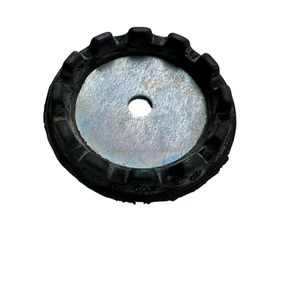
Explore our laboratory-tested driveshaft center support assemblies, leaf spring bushings, and heavy-duty chassis isolators built to exact OE specifications for European, American, and Asian platforms.
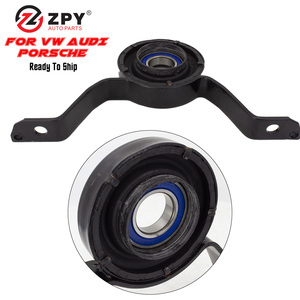
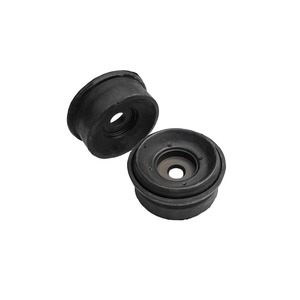
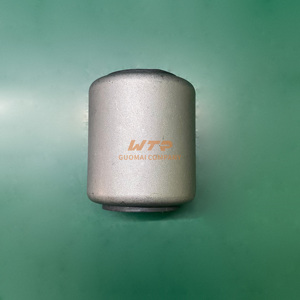
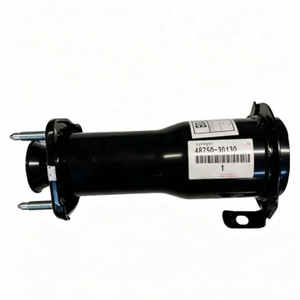
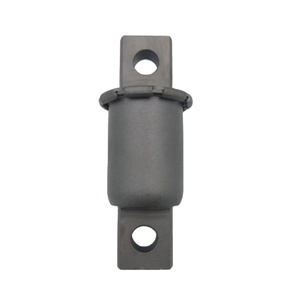
The automotive driveshaft center support assembly (often termed the propeller shaft center bearing cushion) serves as the primary critical decoupling junction in multi-piece driveline architectures. Operating under extreme torsional fluctuations, angular articulation, and high-frequency cyclical vibrations, this sub-assembly dictates overall vehicle Noise, Vibration, and Harshness (NVH) characteristics.
In modern rear-wheel-drive (RWD), all-wheel-drive (AWD), and four-wheel-drive (4WD) drivetrains, the driveshaft center support bearing is tasked with an inherently conflicting objective: maintaining rigorous structural concentricity of the rotating propeller shaft while simultaneously dissipating harmonic excitation generated by the transmission output shaft, transfer case, and universal/homokinetic joints. Sourcing from premier Chinese manufacturing hubs demands a deep understanding of polymer rheology, deep-groove ball bearing raceway precision, and chemico-mechanical rubber-to-metal bonding.
Premature center support failure accounts for over 42% of driveline-related warranty claims in commercial fleet operations and heavy passenger platforms such as the Porsche Cayenne, VW Touareg, Dodge Charger, and heavy-duty utility trucks. When an inferior rubber cushion deteriorates due to thermal degradation, ozone cracking, or shear stress, severe driveline shudder manifests between 30 km/h and 70 km/h under acceleration. This dynamic imbalance cascades catastrophic vibrational stress directly into the transmission tail housing and rear differential pinion bearings.
To eliminate these vulnerabilities, leading Chinese suppliers utilize advanced Natural Rubber (NR) compounds enhanced with high-structure carbon blacks and synthetic Ethylene Propylene Diene Monomer (EPDM) blends. By implementing automated computer-controlled internal mixers (Banbury mixers) and vulcanization compression molding presses, elastomer hardness is calibrated precisely between 55 to 65 Shore A. This tight window delivers the exact loss factor (η) and dynamic stiffness required to neutralize low-frequency resonance without transmitting high-frequency gear whine into the unibody chassis.
Concurrently, the internal deep-groove ball bearing must conform to strict ISO 3534 / ABEC-3 or higher tolerance standards. Utilizing high-carbon chromium bearing steel (GCr15/AISI 52100) with vacuum degas treatment, raceways are superfinished to a surface roughness of Ra ≤ 0.08 μm. Sealed with multi-lip fluoroelastomer (FKM) or polyacrylic (ACM) radial contact shields filled with polyurea synthetic high-temperature grease (-40°C to +160°C), our center bearings resist muddy washouts, road salts, and thermal spikes during sustained highway towing.
| Engineering Parameter | Tier-1 OE Specification | Our In-House Standard (China Factory) | Generic Commodity Aftermarket |
|---|---|---|---|
| Rubber Compound Material | Virgin NR/EPDM blend with anti-ozonant wax | 100% Virgin NR/EPDM with micro-dispersed carbon | Recycled crumb rubber blend (reclaim) |
| Elastomer Hardness (Durometer) | 58 ± 3 Shore A | 58 ± 2 Shore A (Strict Rheometer Batching) | 68 - 75 Shore A (Harsh vibration transfer) |
| Rubber-to-Metal Bonding Strength | ≥ 8.5 MPa (ASTM D429 Method B, 100% rubber tear) | ≥ 10.2 MPa (Two-coat Chemlok thermal fusion) | ≤ 4.0 MPa (Adhesive peel, premature delamination) |
| Bearing Radial / Axial Play | Radial: 5-12 μm; Axial: ≤ 20 μm | C3 Internal Clearance (Controlled 8-15 μm) | Uncontrolled (> 35 μm, generates driveline play) |
| Grease Fill & Thermal Threshold | Polyurea synthetic, -40°C to +175°C | Mobil/Kyodo Yushi high-temp synthetic (-40°C to +165°C) | Low-grade lithium grease (drops out < 90°C) |
| Dynamic Endurance Cycle | 1,000,000 cycles at 3,500 RPM under 4.5 kN load | 1,200,000 cycles validated on dyno rig | < 250,000 cycles (premature fatigue failure) |
Rubber-to-metal separation remains the single greatest vulnerability in driveshaft center bearings subjected to heavy torque spikes. At our manufacturing facility, cold-rolled stamped steel brackets (Q235 / SPCC) undergo strict shot-blasting, alkaline degreasing, and micro-etch zinc phosphate pre-treatment before robotic application of Lord Chemlok® dual-layer vulcanization bonding agents. Under 180°C vulcanization mold pressure, the elastomer chains co-polymerize directly with the primer layer, producing a molecular bond where metal will yield before rubber separation occurs.
How Tier-1 consolidators, warehouse distributors, and automotive aftermarket brands are navigating supply chain shifts, electrification, and dual-shore manufacturing partnerships.
With thousands of multi-piece driveshaft variants across global vehicle fleets, procurement teams are rapidly abandoning single-item traders in favor of vertically integrated factories that maintain an exhaustive catalog. Offering cross-references across 9,485+ SKUs—spanning Porsche Cayenne (4G0521101C), Audi Q7 (4M0616039AC), and MAN Truck leaf spring bushings—lowers warehouse administrative overhead by over 30%.
As light commercial vehicles (LCVs) and SUVs shift to hybrid and dual-motor AWD architectures, instant electric motor torque spikes subject propeller shafts to violent rotational shock. Sourcing managers are requiring center supports engineered with progressive-rate rubber stiffness and dual-frequency dampers capable of absorbing instantaneous torque without high-frequency cabin booming.
Global wholesale distributors are shifting procurement policies away from blind low-cost bidding toward comprehensive production part approval process (PPAP) verification. Demands now mandate raw material spectrographic reports, rheometer cure curves per batch, 3D coordinate measuring machine (CMM) dimensional reports, and salt spray test certificates (≥ 240 hrs ASTM B117).
Stringent European environmental directives (REACH, RoHS, and California Proposition 65) strictly prohibit carcinogenic polycyclic aromatic hydrocarbons (PAHs) and nitrosamines in rubber vulcanizates. Leading Chinese exporters have retooled compounding recipes to incorporate non-toxic aromatic-free processing oils and eco-friendly vulcanization accelerators without compromising elastic modulus.
Rather than evaluating unit FOB purchase price in isolation, global procurement leaders prioritize supply chain reliability, packaging durability (individual moisture-barrier shrink-wrapping), barcoded private labeling, and defect rates below 15 PPM (parts per million). A single defective container of center bearings can instantly erase years of margin advantages.
Combining complete vertical integration—from custom chemical compounding and precision stamping to automated vulcanization—ensuring unyielding consistency across high-volume production runs.
Unlike assembly shops that outsource rubber vulcanization to third-party sub-suppliers, our production lines perform 100% of internal compound mixing, pre-forming, injection/compression molding, and cryogenic deflashing in-house. We maintain complete custody of compound rheology from raw polymer bales to finished products.
Every single part number is reverse-engineered against factory-original OE samples using laser coordinate scanners. We replicate critical mounting hole pitch, bracket offsets, bearing bore diameters, and rubber cushion wall thicknesses down to ±0.05 mm, guaranteeing plug-and-play installation for technicians worldwide.
Our rapid-tooling workshop supports over 31 global automotive marques: Toyota, Nissan, Honda, Mitsubishi, Isuzu, Ford, Mazda, Chrysler/Dodge/Jeep, MAN, Mercedes-Benz, BMW, and Porsche. We maintain thousands of ready-to-ship molds, slashing tooling lead times for discontinued or niche catalog applications.
Our QA lab is equipped with computerized tensile test machines, Mooney viscometers, moving die rheometers (MDR), dynamic fatigue test rigs, multi-axis shaker tables, and ozone environmental chambers (50 pphm @ 40°C). Every batch undergoes rigorous quality validation before packing.
We provide full-spectrum turnkey packaging solutions: customized full-color retail boxes with anti-counterfeiting holographic seals, custom laser-etched part numbers and QR codes directly on metal brackets, and heavy-duty export palletizing designed to prevent shipping deformation.
Expert answers addressing the commercial, technical, and logistics queries most frequently posed by global parts buyers and Tier-1 category managers.
Direct factory pricing, OEM-grade rubber-to-metal bonding, and complete cross-referenced coverage for over 9,485 vehicle chassis and driveline components. Connect with our engineering sales team now.
Inquire Now