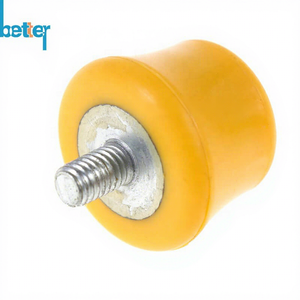
Bonding Silicone Rubber to Metal Shock Absorber Bushing
- • Material: Chemically Bound Silicone / NBR
- • Hardness: 65 Shore A ± 5
- • Application: Shock Absorption, Low NVH

Explore our industrial-grade automotive suspension components. Every part is produced with advanced rubber-to-metal vulcanization lines to exceed rigorous ISO 9001 and IATF 16949 standards.
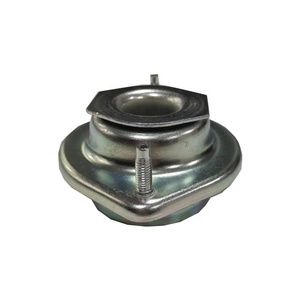
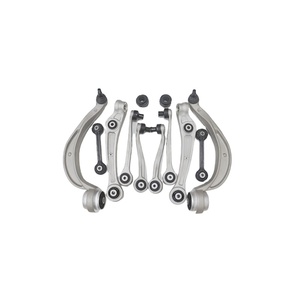
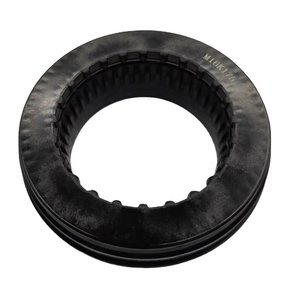
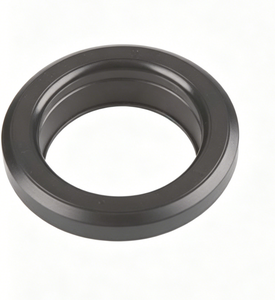
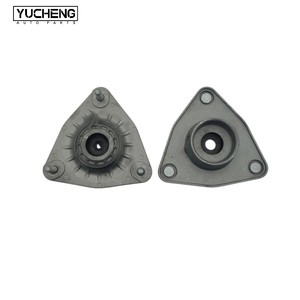
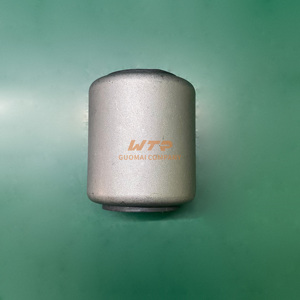
Torque rod bushings serve as the pivotal mechanical anchors in multi-axle heavy-duty trucks, articulated trailers, and passenger vehicle subframes. Operating as critical elastomeric hinges, they absorb immense tractive forces, braking reaction moments, and lateral thrust without allowing chassis misalignment.
Traditional cheap aftermarket bushings fail prematurely due to micro-voids during rubber curing, uneven polymer dispersion, and poor Chemlok adhesive priming. Our manufacturing facilities utilize vacuum-assisted injection molding alongside automated multi-stage metal phosphating to deliver unyielding adhesive shear strengths exceeding 12 MPa.
| Performance Metric | Standard Aftermarket | Our Heavy-Duty Specification |
|---|---|---|
| Base Elastomer | Recycled NR Blends | 100% Virgin Natural Rubber (NR) / EPDM |
| Inner Sleeve Metallurgy | Standard Low Carbon Steel | Seamless 40Cr / 20# Case-Hardened Alloy |
| Tensile Strength | 12 - 14 MPa | ≥ 22.5 MPa |
| Elongation at Break | 350% | ≥ 550% (Dynamic Resilience) |
| Thermal Stability Range | -20°C to +80°C | -45°C to +125°C Continuous |
| Ozone & Oil Degradation | Cracking under 72h ASTM | Zero Surface Cracking > 168h ASTM D1149 |
As commercial transportation evolves toward electrification, zero downtime, and increased gross axle weight ratings, torque rod bushing manufacturing is transforming rapidly.
Electric commercial vehicles generate immediate maximum torque, exerting extreme instantaneous shear loads onto torque control rods. Modern bushing engineering focuses on progressive dual-rate stiffness profiles that maintain high soft compliance at small micro-vibrations while stiffening rapidly under violent acceleration.
Replacing conventional carbon black with hybrid organosilane-functionalized precipitated silica improves high-frequency hysteresis loss. This reduces internal heat generation within thick torque rubber blocks, preventing thermal degradation and extending operational life under continuous long-haul fleet duty cycles.
Demands for superior ride comfort have prompted integration of internal micro-hydraulic chambers within torque links. Concurrently, cast polyurethane and thermocured elastomer hybrids are replacing standard vulcanized bushes in chemical-intensive hauling sectors where fuel, grease, and road salt attack standard compounds.
B2B importers, tier distributors, and OEM buyers must navigate changing compliance protocols, raw material spikes, and shipping optimizations.
Major European and North American distributors increasingly favor comprehensive chassis replacement bundles. Procurement teams specify torque rods matched with identical factory-pressed bushings, nuts, and subframe link brackets to guarantee fitment accuracy and cut logistics overhead.
Cross-border supply chains require strict environmental audit trails. Tier-1 buyers demand RoHS and REACH compliant compound formulations devoid of polycyclic aromatic hydrocarbons (PAHs), along with material test certificates verified under optical emission spectrometry (OES).
To guard against component unbonding or metal sleeve fractures, procurement departments bypass packaging brokers. Preference is given entirely to certified direct manufacturers possessing internal tooling, stamping, phosphating, vulcanization, and end-of-line fatigue testing equipment.
Direct-from-factory reliability built on continuous tooling investment, deep inventory, and complete compound control.
A massive production matrix spanning over 60 distinct categories including torque rod assemblies, engine mountings, control arm bushings, suspension buffers, and center support bearings.
Comprehensive fitment cross-referencing for European, American, Japanese, and domestic heavy commercial vehicle platforms such as MAN, Mercedes-Benz, Volvo, Scania, Ford, Isuzu, and Hino.
From raw polymer mastication and compound blending to metal sleeve chemical surface conditioning and compression molding, every stage happens inside our own controlled facilities.
Extensive warehousing with thousands of pre-machined steel sleeves and standard catalog lines, reducing export shipping cycles and ensuring responsive container-load fulfillments.
Get clear technical, ordering, and logistics answers regarding our torque rod bushing and suspension product lines.
Key parameters include inner core diameter, outer sleeve diameter, overall length, mounting hole center distance, and torsional deflection angle. In heavy applications, specifying radial dynamic stiffness (N/mm) and rubber Shore hardness (typically 65-75 Shore A for heavy truck torque rods) guarantees proper suspension dampening.
We execute a 4-step surface conditioning system: shot blasting metal sleeves to achieve Sa 2.5 cleanliness, automated hot-dip zinc phosphating, dual-coat adhesive application (phenolic primer + elastomeric adhesive), followed by temperature-controlled vulcanization under 200+ tons of hydraulic clamping force.
Yes. Our engineering department can reverse-engineer physical samples or manufacture according to 2D/3D CAD models. Our tooling workshop fabricates precision transfer or injection molds within 15 to 25 business days, delivering dimensional first-article inspection reports (FAIR).
Our expansive catalog covers 31 major makes, including MAN, Volvo, Scania, DAF, Mercedes-Benz Actros, Iveco, Freightliner, Kenworth, Isuzu, Hino, Mitsubishi Fuso, Toyota, and Audi, verified with OE-cross-reference part listings.
Every production batch undergoes rheometer curing curve profiling, tensile elasticity checks, axial push-out load testing (verifying bond strength), 100% CMM dimensional tolerance verification, and sample multi-axis cyclic fatigue testing up to 1.2 million oscillations.
For items already supported by existing tooling or in ready stock, MOQs start from 50 to 100 units. For bespoke compounds or proprietary mold dimensions, standard trial runs require 300 to 500 units, with typical lead times spanning 20 to 35 days depending on batch volume.