Heavy Duty
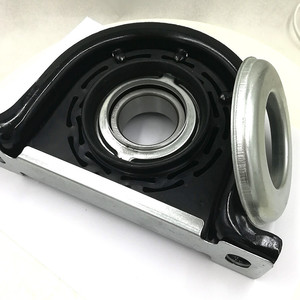
HB88509 Steel Rubber Drive Shaft Center Support Bearing Pillow Block Type
Application: Commercial Trucks • OE Ref: HB88512, HB88508, HB88107
Inquire Now

Center bearing supports serve as the primary rotational and torsional stabilization link in split propeller shaft architectures. By pairing premium steel housings with precision vulcanized rubber cushions, China's export manufacturing standard ensures zero harmonic resonance, seamless torque transfer, and extended universal joint life.
Examine our precision-machined, vulcanized rubber-to-metal center support bearings manufactured to exact OEM dimensions for global chassis applications.
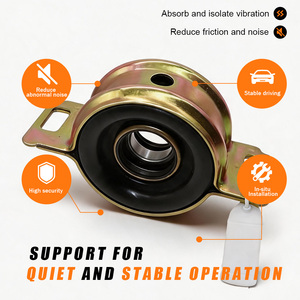
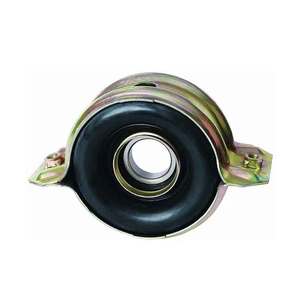
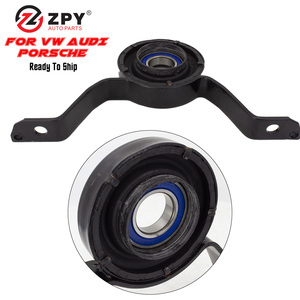
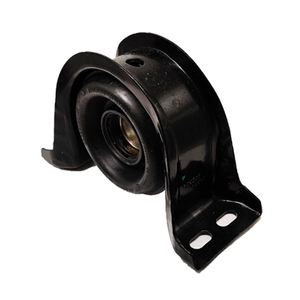
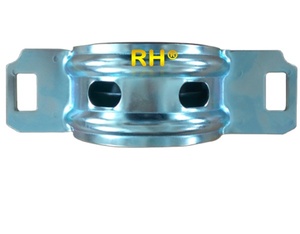
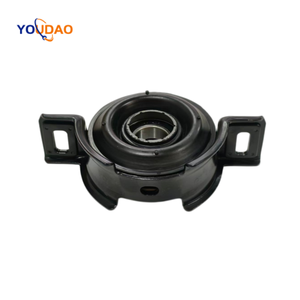
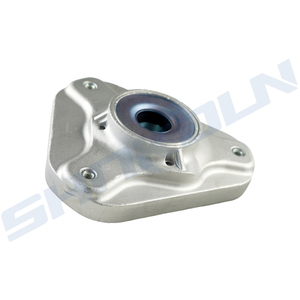
Evaluating the metallurgical precision and chemical compounding technologies that drive the performance of modern propeller shaft center supports.
Raw elastomer formulation tailored to Shore A 55–65 hardness delivers optimal resilience against thermal aging (-40°C to +120°C), road ozone exposure, and heavy diesel fuel immersion without loss of dampening cohesion.
Advanced dual-coat vulcanization bonding agents guarantee peel strengths exceeding 10 MPa. Metal collars undergo automated phosphate etching, preventing premature de-bonding under heavy acceleration shock torque.
Precision ABEC-3 / P6 core bearing assemblies packed with synthetic polyurea grease. Fitted with multi-lip labyrinth contact seals to completely block water spray, road salt, grit, and industrial chemical contaminants.
Combining high-capacity automated molding lines with exhaustive laboratory inspection protocols to eliminate supply chain disruptions and product return liabilities.
With over 9,485 catalogued parts across 60 specialized chassis categories, every tooling bracket, rubber diaphragm, and dust shield is designed and maintained by in-house tooling engineers. This eliminates third-party manufacturing variations and guarantees uniform batch tolerances.
Our catalog supports extensive Japanese, American, European, and Asian commercial and passenger applications: Toyota, Nissan, Ford, Isuzu, Mitsubishi, Honda, Mercedes-Benz, Hino, and Chevrolet. We maintain immediate inventory on key part numbers to expedite wholesale distribution.
Every batch passes mechanical deflection benchmarks, radial and axial fatigue cycle stress tests (>1,000,000 cycles under load), and high-frequency vibro-acoustic bench testing. Our parts are engineered to meet or exceed OEM service lifespans across diverse operational environments.
Benchmark our OEM-grade vulcanized rubber assemblies against inferior market alternatives to optimize long-term maintenance costs and eliminate field warranty failures.
| Evaluation Parameter | Our OEM Factory Specification | Low-Cost Market Generic | Impact on Driveline NVH |
|---|---|---|---|
| Elastomer Compound | 100% Virgin Natural Rubber + Anti-Ozonant Wax | Recycled Rubber / High Carbon Black Fill | Absorbs 98% driveline harmonics |
| Metal Bracket Fabrication | Cold-Rolled SPCC / Q235B with E-Coating | Scrap Stamped Iron / Basic Spray Primer | Resists 500+ hrs salt spray |
| Bearing Grade & Tolerance | GCr15 High-Carbon Chrome (ABEC-3 / P6) | Carbon Steel (ABEC-1 or unrated) | Zero rotational runout & rumble |
| Lubricant Specification | Mobil / Shell Polyurea Synthetic (-40°C~160°C) | Generic Mineral Grease (<80°C limit) | No grease liquefaction under load |
| Bonding Shear Strength | Chemlok Chemical Vulcanization (≥10.5 MPa) | Direct Pressure Fit / Low-Grade Resin | Eliminates high-torque tear-off |
Key industry shifts shaping procurement strategies for international chassis component buyers over the coming years.
As hybrid commercial vehicles and dual-motor AWD platforms expand, center support bearings experience instantaneous peak torque spikes. Forward-thinking procurement teams are upgrading to compound-reinforced multi-lip center supports engineered for instant forward-reverse load shifts without rubber hysteresis breakdown.
Fleets operating in cold-climate regions (Nordics, North America, Central Asia) require custom synthetic EPDM-NR formulations. Conventional rubber cushions harden at sub-zero temperatures, causing severe driveline shudder; next-generation procurement specifies glass-transition temperatures (Tg) below -45°C.
Global importers must increasingly comply with European carbon border adjustment mechanisms and corporate ESG targets. Factories utilizing eco-cured vulcanization accelerators and low-VOC bonding primers provide international distributors with a clear competitive advantage in regulatory audits.
Practical insights on technical compliance, sample verification, packaging standards, and lead times for global importers and distributors.
The two most common failure modes are improper driveline operating angles (inducing severe angular runout) and low-grade rubber-to-metal bonding that delaminates under torque spikes. Secondary failures stem from inferior bearing seal lip design, which allows water spray and fine abrasive dust into the bearing race.
Yes. Our engineering division operates dedicated CNC tooling and laser-cutting facilities. If you supply original samples, 2D blueprints, or 3D STEP files, our team can complete dimensional verification, compound matching, prototyping, and tooling sign-off within 20 to 30 working days.
While driveshafts are balanced on dedicated driveline balancers, center support bearings must maintain strict concentricity (concentric runout ≤ 0.05 mm) and uniform durometer across 360 degrees. Our parts undergo runout inspection to ensure no rotational wobble is transmitted to the cardan joints.
We support full private labeling services for regional aftermarket brands. Packaging options include customized color boxes, laser-etched part numbers and batch codes, barcoded QR labels, anti-rust VCI film bags, and export-grade pallet packaging built for sea freight protection.
Connect directly with our engineering and export sales specialists. Send us your required OE numbers, annual purchasing volume, or customized chassis drawings for a prompt technical assessment and quotation.
Inquire Now