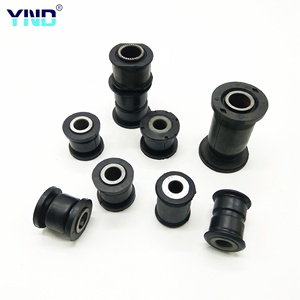
Manufactured to rigorous OEM tolerances with virgin Natural Rubber (NR), EPDM, and polyurethane compounds bonded dynamically to phosphatized steel and aerospace aluminum alloy sleeves.
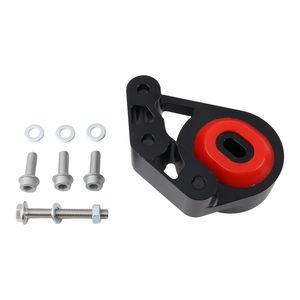
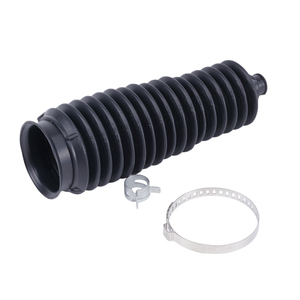
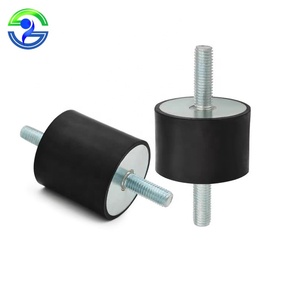
Rear axle bushings form the mechanical nexus between dynamic unsprung wheel assemblies and the sprung structural chassis, requiring precise radial, axial, and torsional compliance.
In modern twist-beam axles and independent multi-link rear suspensions, the rear axle bushing is subjected to tri-axial dynamic stresses: high torsional displacement during body roll, severe radial impact loading under braking/acceleration, and continuous axial shear. To maintain suspension geometry and toe/camber parameters, the rubber-to-metal bonding must withstand shear stresses exceeding 12 MPa without delamination, certified under ASTM D429 standards.
We tailor durometer hardness from 50 Shore A to 85 Shore A utilizing virgin polyisoprene and butadiene polymers. Compounds undergo strict carbon black dispersion checks, yielding high tensile elongation (>450%) and low permanent compression set (<18% at 70°C / 22h).
Rear axle bushings integrate specialized voiding patterns, hydraulic chambers, or internal travel limiters to isolate structural vibrations in the 20 Hz to 200 Hz frequency band, preventing low-frequency booming inside the passenger cabin.
Precision dual-coat adhesive application onto micro-shotblasted, phosphatized seamless steel tubes ensures an unbreakable chemical cross-link during high-pressure compression/transfer injection molding.
| Performance Characteristic | OEM Standard Specification | Our Factory Production Standard | Sub-Standard Aftermarket Bushings |
|---|---|---|---|
| Tensile Strength (MPa) | ≥ 17.5 MPa | ≥ 21.0 MPa (Virgin NR Matrix) | 10.0 – 12.5 MPa (Recycled scrap rubber) |
| Rubber-Metal Peeling Force | ≥ 10.0 kN/m (100% Rubber Tear) | ≥ 12.8 kN/m (ASTM D429 Method B) | < 5.5 kN/m (Adhesive interface failure) |
| Dynamic Fatigue Life Cycle | 300,000 cycles (±10mm @ 2.5Hz) | ≥ 500,000 cycles zero-crack retention | < 100,000 cycles (Premature splitting) |
| Corrosion Resistance (Sleeve) | 240 Hours Neutral Salt Spray | 480+ Hours (Geomet / E-Coat Zinc) | < 48 Hours (Standard unsealed zinc) |
| Operating Thermal Range | -40°C to +90°C | -45°C to +115°C (Stabilized formula) | -20°C to +70°C (Hardens in cold) |
Automotive electrification (EVs), lightweighting initiatives, and geopolitical supply chain adjustments are shifting the specifications of chassis rubber bushings globally.
Battery electric vehicles (BEVs) exhibit a 25–35% higher curb weight and instantaneous torque profiles compared to traditional ICE vehicles. Procurement teams are demanding rear subframe and axle bushings with elevated radial load capacities without increasing component dimensions. This has led to the adoption of high-damping polyurethane composites and dual-chamber hydraulic bushings that restrict longitudinal squat during dynamic acceleration.
To reduce unsprung chassis mass, original equipment manufacturers are replacing zinc-plated carbon steel outer sleeves with 6000-series structural aluminum alloys or continuous fiber-reinforced thermoplastics (PA66-GF30). Exporters with in-house CNC machining and multi-metal pretreatment tanks offer significant weight reduction and zero electrolytic corrosion risks.
Global aftermarket distributors and OEM Tier-1 buyers require complete raw material provenance. Procurement workflows now mandate International Material Data System (IMDS) verification, REACH SVHC declarations, and barcode laser-etching on outer sleeves to guarantee automated inventory traceability from China factory gates to regional distribution hubs.
From compound formulation to final press-fit calibration, our integrated supply chain eliminates intermediaries, offering industrial resilience and scalable production capacity.
Equipped with high-speed 5-axis CNC machining centers, EDM wire cutting, and rheological mold flow simulation software, our internal mold fabrication center can deliver custom-engineered tooling prototypes within 20 working days from 2D/3D CAD submission.
Every manufacturing stage is governed by strict APQP and PPAP Level 3 protocols. Our metallurgical and elastomer testing facility is equipped with MTS dynamic servo-hydraulic test benches, ozone aging chambers (-40°C to 150°C), and CMM coordinate measurement instruments.
Our catalog includes over 9,485 actively molded chassis rubber parts, matching OEM references for Toyota, Honda, Nissan, Mitsubishi, Ford, GM, BMW, Mercedes-Benz, Audi, Hyundai, Kia, and commercial truck applications such as Hino and Isuzu.
Clear, definitive technical and commercial answers to facilitate seamless cross-border sourcing.
For existing tooling catalog references, our standard minimum order quantity starts at 200–300 units per line item. For bespoke custom compounding or proprietary new mold fabrication, MOQs typically range from 500 to 1,000 units depending on component volume and sleeve machining specifications.
Our outer and inner metal sleeves undergo continuous ultrasonic degreasing, shot blasting to achieve an Ra 3.2μm profile, and zinc-iron or zinc-nickel electro-coating tested for 480+ hours under neutral salt spray (ASTM B117). We apply automated robotic spray systems for Chemlok primers to eliminate human error.
Yes. Our engineering laboratory features tri-axial dynamic servo testing systems that measure radial, axial, conical, and torsional spring rates. We adjust elastomer rheology, carbon black reinforcing grades, and interior geometric void structures to replicate your precise K-rate deflection curves.
Every commercial production batch is supplied with comprehensive quality documentation, including raw material polymer analysis certificates (COA), 3.1 metallurgical test reports for metal inserts, batch cure rheometer curves, dimensional inspection sheets, and full PPAP Level 3 documentation upon request.
Send our engineering team your OE part numbers, 2D technical drawings, or physical reference samples for immediate cost modeling and cross-reference validation.