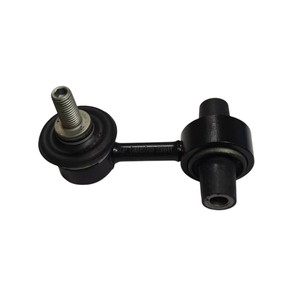
Manufactured in-house with full compound traceability, high flex-fatigue resistance, and strict dimensional tolerances matching global OE technical requirements.
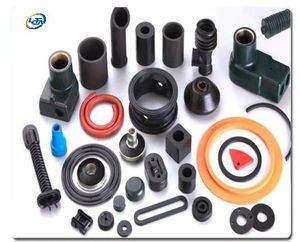
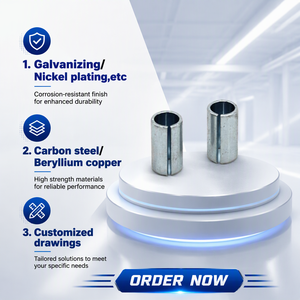
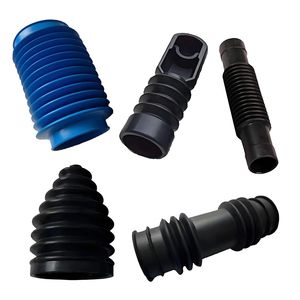
Demystifying elastomeric performance under extreme dynamic flex cycles, grease aggression, and environmental shear stresses.
Dust boot longevity depends entirely on compound matching. Polychloroprene (Neoprene / CR) offers exceptional dynamic flex resistance for conventional drivelines. For high-temperature underhood rack-and-pinion and turbo-adjacent driveshafts, Ethylene Acrylic (AEM) and Fluoroelastomers (FKM) prevent hardening and radial cracking.
When operating under high lithium-complex grease immersion, custom vulcanized NBR/HNBR compounds prevent plasticizer extraction and volumetric swelling.
Dynamic failure often stems from improper stress concentration at the convolute roots. Our tooling engineers utilize Non-Linear Finite Element Analysis (FEA) to model wall-thickness variations during articulation, ensuring constant stress distribution under angles up to 45 degrees.
Optimized bellow radiuses eliminate auto-contact abrasive wear and inner convolute vacuum collapse during high-speed rotational cycles.
A dust boot is only as resilient as its interface with mating housings. We incorporate labyrinth dual-bead clamping profiles designed for stainless-steel Oetiker ear clamps and infinite band clamps.
This engineered interface prevents grease leakage under centrifugal pressures and blocks sub-micron silica, moisture, and road de-icers from penetrating vital ball joints and tripod assemblies.
| Polymer Type | Operating Temp Range | Flex Fatigue Life | Grease Resistance | Ozone & Weathering | Primary Application Focus |
|---|---|---|---|---|---|
| CR (Neoprene) | -40°C to +105°C | Exceptional | Moderate to High | Very Good | Standard CV Joints, Ball Joints, Tie Rod Ends |
| EPDM | -50°C to +135°C | High | Low (Not for Hydrocarbons) | Superior | Steering Gear Bellows, Brake Caliper Guide Pins |
| NBR / Nitrile | -30°C to +120°C | Good | Superior | Moderate | Industrial Splines, Transmission Actuators |
| TPE / TPE-E (Thermoplastic) | -40°C to +125°C | Superior (Tear Proof) | Exceptional | Superior | High-RPM Outboard Constant Velocity Boots |
| AEM (Vamac®) | -40°C to +160°C | Very High | Exceptional | Superior | High-Temperature Turbo Driveline Applications |
How electrification, severe duty duty-cycles, and supply chain nearshoring are reshaping global rubber component procurement.
Electric vehicles generate instant torque and lower center-of-gravity architectures, forcing CV boots and suspension joints to endure continuous articulation angles beyond 42 degrees with higher angular acceleration.
Procurement teams are shifting away from generic rubber compounds toward low-hysteresis elastomer formulations that resist frictional internal heat build-up.
Modern Tier-1 driveline OEMs are increasingly pairing rubber inner boots with blow-molded or injection-molded TPC-ET outer boots for front transaxles.
Thermoplastics offer superior puncture resistance against stone impingement at high wheel speeds, prompting suppliers to maintain dual tooling capabilities for both vulcanized elastomers and thermoplastics.
Global environmental regulations (EU REACH, RoHS, California Prop 65) dictate stringent limits on polycyclic aromatic hydrocarbons (PAHs) and heavy metal curing activators.
Forward-looking manufacturers integrate bio-based plasticizers, eco-vulcanizers, and micronized post-industrial rubber without compromising DIN abrasive wear or tensile specifications.
As global importers mitigate geopolitical vulnerabilities and tariff disruptions, Thailand has emerged as the premier manufacturing powerhouse for automotive elastomers.
Direct access to premium natural rubber latex reserves and sophisticated local chemical processing chains lower shipping transit cycles and material processing costs.
From custom elastomer compounding to automated multi-cavity vulcanization, complete internal ownership guarantees uncompromised quality.
Unlike trading agencies that broker jobs out to third-party contract shops, all NISTO rubber dust boots and chassis components are molded directly on our automated lines in Thailand.
We control temperature, curing time, cavity vacuuming, and rubber-to-metal bonding adhesion under strict ISO9001 certified quality control protocols.
Covering Japanese, American, and European applications across 31 vehicle marques. Every SKU carries complete OE reference mappings, actual product photography, and verified fitment data.
Our extensive archive significantly compresses procurement validation periods for aftermarket distributors and chassis rebuilders.
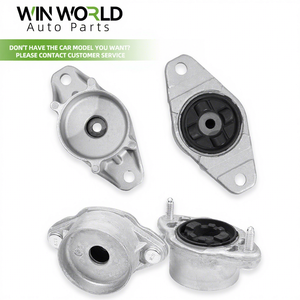
Whether you require high-durometer Shore 90A bushings, oil-resistant HNBR dust covers, or bespoke shock absorber strut mounts, our tooling workshop delivers quick-turn prototypes.
We engineer precision tooling from CAD/STEP models or worn OEM physical samples, providing rapid turnarounds from initial concept to pilot run.
Detailed technical clarifications addressing compounding, minimum order quantities, reverse engineering, and lifecycle durability testing.
Connect directly with our engineering specialists in Thailand to discuss your custom CAD specifications, OE cross-references, or high-volume private label requirements.
Contact Us