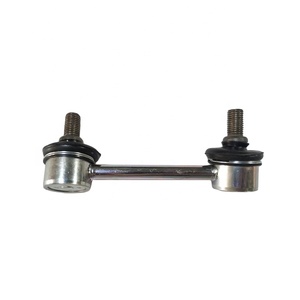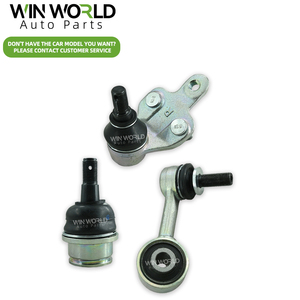
Engineered to exact OEM tolerances, featuring advanced chloroprene sealing boots, micro-finished ball pins, and high-tensile connecting rods for ultimate road stability.
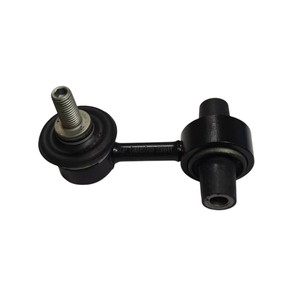
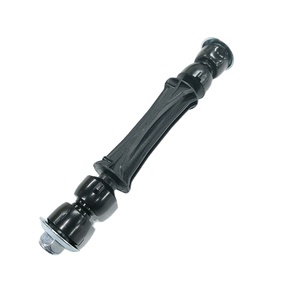
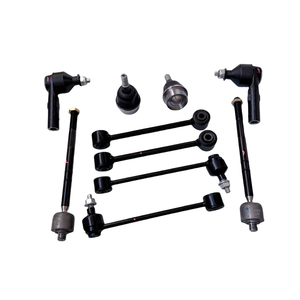
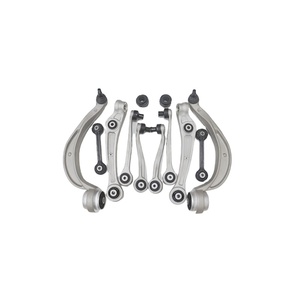
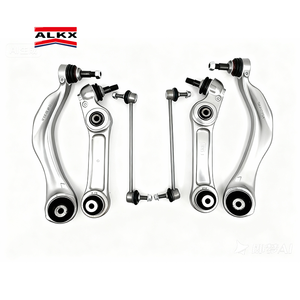
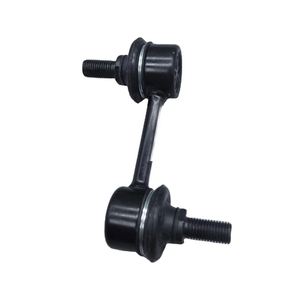
A vehicle's anti-roll system relies heavily on the stabilizer bar link (also termed sway bar link rod or anti-sway link) to bridge the chassis sway bar with the suspension knuckle or strut assembly. Under severe lateral acceleration, centrifugal weight transfer creates torsional strain across the vehicle body. As seasoned stabilizer bar link manufacturers and exporters in Mumbai, our metallurgical processes and precision vulcanization ensure zero premature shearing, reduced NVH (Noise, Harshness, and Vibration), and optimal handling dynamics across passenger, light commercial, and heavy-duty vehicles.
Our integrated manufacturing facilities deploy carbon-alloy structural steel (such as 40Cr and SAE 1045) for the center link rods, combined with precision friction welding or robotic MAG continuous welding. Ball sockets are encapsulated with reinforced polyoxymethylene (POM-GF) low-friction seats and sealed using heavy-gauge polychloroprene rubber dust boots. These boots resist ozone cracking, high ambient temperatures, and petro-chemical attack, preserving internal lithium complex greases across millions of continuous oscillations.
Situated adjacent to the Jawaharlal Nehru Port Trust (JNPT/Nhava Sheva) and supported by extensive precision tooling corridors across Thane-Belapur, Navi Mumbai, and Pune industrial zones, Mumbai stands as India's vital gateway for automotive chassis exports. Procurement teams across Western Europe, the Middle East, Southeast Asia, and the Americas benefit directly from Mumbai's concentrated engineering talent, integrated metal treatment facilities, and low-latency maritime logistics.
Direct logistical access to JNPT facilitates rapid container turnaround, shortened dwell intervals, and highly economical consolidation for FCL and LCL shipments globally.
Immediate access to certified steel billet stock, advanced polyurethane formulations, and specialty elastomers ensures robust volume manufacturing without supply delays.
Equipped with sophisticated in-house tooling workshops, custom OE sample reverse-engineering, CMM validation, and prototype validation can be accomplished within 15 working days.
The global transition toward battery electric vehicles (EVs) and high-riding crossover platforms has rewritten the performance metrics of steering and suspension assemblies. Heavier vehicle curb weights, instant torque transfer, and silent powertrains dictate zero-tolerance standards for acoustic emissions and fatigue endurance.
Development of carbon-fiber reinforced polyamide link rods alongside traditional cold-drawn steel rods, cutting unsprung mass by 38% while sustaining equivalent torsion yield limits.
Reinforced ball socket architectures engineered specifically to combat accelerated micro-chatter caused by massive instantaneous axle torque in platforms like Tesla Model X.
Hexavalent chromium-free electro-deposition surface finishes providing in excess of 1,000 hours of continuous neutral salt spray (ASTM B117) corrosion immunity.
Unlike trading entities, we offer comprehensive in-house control from compounding rubber polymers to cold-heading metal pins and automated bonding. Our manufacturing heritage guarantees consistent dimensional repeatability, stringent OE cross-referencing, and flexible private-label customization.
From initial raw polymer compounding to CNC sphere turning, every stage occurs on dedicated factory lines to maintain strict dimensional repeatability.
Formulated against genuine factory tolerances with high-adhesion rubber-to-metal bonding, matched shore durometers, and precise fitment across 31 vehicle marques.
Over 9,485 line items ready for export, spanning engine mounts, control arm bushings, suspension dampers, CV boot kits, center support bearings, and link rods.
End-to-end bespoke packaging services, laser-etched OEM numbers, custom barcodes, and export-grade palletization tailored for international distribution brands.
Essential guidance for fleet procurement directors, automotive wholesale importers, and Tier-1 distributors sourcing stabilizer bar links and chassis components.
Connect directly with our engineering sales desk for full container schedules, cross-referenced OEM catalogs, or custom product inquiries. Fast turnaround on all international RFQs.